6 points Bill Gates makes about AI risk and why self-regulation fails
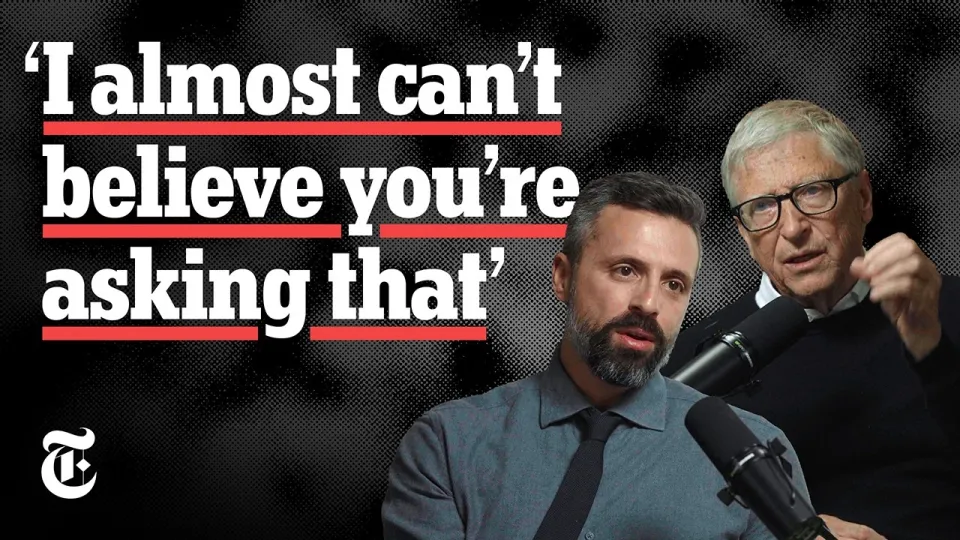
Video: Bill Gates: A.I. ‘Makes Nuclear Weapons Look Like Nothing’ | The Ezra Klein Show
Want articles like this for your own video to promote it on YouTube and Google? Order them through the Telegram bot @sat_sit_bot. It writes articles around your video, embeds the video and publishes them on popular niche websites (no ads). Your first 50 articles are free.
· based on the channel The Ezra Klein Show
Key takeaways
- Gates calls the idea that the AI industry can self-regulate "insane" and says liability lawsuits are no answer to catastrophic harm.
- He flags two danger thresholds — cyberattacks and bioterrorism — as the points where AI moves from useful tool to existential threat.
- Gates argues AI may rival nuclear weapons in risk, a claim he ties to how fast systems became superhuman at specific tasks.
- Mass job displacement and growing inequality between rich and poor countries are treated as near-certain, not speculative.
- The Gates Foundation is set to spend down roughly $200 billion over two decades, with AI-driven equity as a new priority.
Bill Gates argues that AI is the most dangerous technology humanity has approached, that the industry cannot be trusted to police itself, and that governments must set hard thresholds for cyber and biological risk before catastrophic harm occurs. His case, made on The Ezra Klein Show, is that the alarmism many critics find excessive has not gone far enough — you can read the full transcript of the conversation here.
Why Bill Gates says AI alarmism has not gone far enough
Gates, who spent decades as a technologist before turning to philanthropy, describes himself as more frightened than the public debate assumes. In the episode he repeatedly pushes back on the framing that AI risk is a distant or speculative problem, arguing that the systems now being built are already crossing lines that matter. The comparison he reaches for is nuclear weapons — and his point is that AI may make that earlier existential threat look modest by comparison.
That is not a claim about a machine waking up and deciding to harm people. It is a claim about capability arriving faster than the institutions meant to contain it. Gates' worry is structural: the people in positions of authority, in his view, are in denial about what is coming, and the gap between the pace of development and the pace of governance is where the danger lives.
The cyber and bio thresholds that change the stakes
The core of Gates' argument is that risk is not spread evenly across all uses of artificial intelligence; it concentrates at two thresholds. The first is cyber: AI that can find and exploit vulnerabilities at a speed and scale no human team can match, enabling attacks on infrastructure, finance and public services. The second is bio: AI that lowers the barrier to designing dangerous biological agents, turning knowledge that once required a laboratory and years of training into something far more accessible.
Once either threshold is crossed, the harm is not a bad product or a bad recommendation. It is mass casualty. That asymmetry — enormous potential damage from a small number of actors — is why Gates treats AI safety as a national-security problem rather than a consumer-protection one.
Why self-regulation fails and lawsuits are no answer
Gates is blunt that the idea of the AI industry regulating itself is, in his word, insane. His reasoning is straightforward: companies compete on speed, capital and market share, and the incentives that make them successful are the same incentives that push safety work to the back of the queue. Asking firms to restrain themselves against their own commercial interest is not a control mechanism.
He is equally dismissive of the idea that liability and litigation can substitute for regulation. A lawsuit arrives after the damage, and it cannot unscramble a catastrophic attack or bring back the dead. The point is not that courts are useless but that they operate on a timescale and logic that do not match the risk. Regulation has to come before the harm, which means governments need to define thresholds, require testing and be willing to stop deployment.
The race with China and the temptation to cut corners
The strongest counterargument to hard rules is competition: if one country slows down, another speeds up. Gates takes the race with China seriously and does not pretend it can be wished away. But he treats it as an argument for coordination, not for abandoning safety. A race in which every participant skips the same checks does not produce a winner; it produces shared exposure to the same catastrophic failure modes.
His position implies a two-track approach: keep the competitive pressure on capabilities, while building international agreement on the narrow set of things nobody should be allowed to do — the cyber and bio thresholds in particular. That is a harder political sell than either pure acceleration or pure restriction, which is part of why he is frustrated with how the debate is framed.
Jobs, inequality and a no-scarcity labor market
Gates does not treat mass job loss as a hypothetical. He expects AI to displace large numbers of workers, and he is skeptical that the transition will be smooth or that markets will handle it automatically. The question he keeps returning to is distribution: the gains from AI will concentrate among those who own the models and the compute, while the costs land on workers and on poorer countries that lack the infrastructure to compete.
Among the ideas raised in the conversation is taxing AI-driven labor, and the notion of "human reserved" jobs — roles where people deliberately keep a human in the loop not because a machine cannot do the task, but because society decides it should not. Gates also points to language and education as areas where AI could widen access rather than narrow it, provided the tools reach the people who currently have the least. His foundation has made AI as a force for equality, rather than inequality, a new priority.
What viewers pushed back on
The reaction to the episode clusters around a few recurring doubts. Many were struck by how visibly agitated Gates seemed — a reaction that itself became an argument, since a technologist with his record being alarmed is treated as evidence that the alarm is warranted. Others focused on the exchange over liability, where Gates' disbelief at the idea of settling catastrophic harm through litigation landed as the sharpest moment of the interview.
A second thread is skepticism toward the market-can-fix-it position associated with AI's biggest cheerleaders. The argument from viewers is that profit incentives have never been a reliable guardrail against industrial harm, and that AI is a poor candidate for the first exception. A third theme is respect for the format: Gates disagrees with questions without interrupting them, and the show leaves those moments in rather than editing them out.
The bottom line on AI risk
Gates' position is not that AI should be stopped but that it is being deployed without the institutions needed to catch it when it fails. The cyber and bio thresholds, the refusal to accept self-regulation, the race with China and the expectation of serious job disruption form a single argument: the costs of being wrong are too large to leave to companies competing on speed. The Ezra Klein Show is where that argument gets tested at length, with a guest who is unusually willing to say the uncomfortable version out loud. For the full conversation and transcript, see the episode page; book recommendations from guests, including this one, are collected here.
Source: Bill Gates: A.I. ‘Makes Nuclear Weapons Look Like Nothing’ | The Ezra Klein Show · Markdown version
Questions & answers
Why does Bill Gates say the AI industry cannot regulate itself?
Because firms compete on speed and market share, and those incentives push safety work down the priority list. Gates calls the idea of self-regulation insane, arguing that asking companies to restrain themselves against their own commercial interest is not a control mechanism.
What are the cyber and bio thresholds Gates warns about?
They are the points where AI capability becomes catastrophic rather than merely disruptive: AI that can find and exploit vulnerabilities at machine speed, and AI that lowers the barrier to designing dangerous biological agents. Once crossed, the harm is mass casualty, which is why he frames AI safety as national security.
Is Gates arguing that AI should be slowed down or paused?
Not exactly. He accepts the competitive race with China as real, but argues that competition is a reason for international coordination on a narrow set of prohibitions, not a reason to abandon testing and deployment rules. The disagreement is about sequencing, not about stopping progress.
What does Gates expect AI to do to jobs and inequality?
He treats large-scale displacement as likely rather than speculative, with gains concentrating among those who own models and compute. The conversation covers taxing AI-driven labor, protecting some roles as human-reserved, and using AI in education and language access to widen opportunity instead of narrowing it.